Love this? Save it for later!
Share the inspiration with your friends
My neighbor Grace watched me hauling a bag of organic bread flour out of my car last Tuesday and didn’t say anything at first. Then she just laughed — that warm, knowing laugh of someone who has seen you do something foolish before. “You’re still buying starter from that bakery downtown?” she called across the fence. I mean, she had me there. I’d been feeding a sourdough starter for three months, but somehow I still couldn’t get my focaccia to turn out right. It was always either too dense or it had that sad, pale crust that reminded me of cafeteria bread. She walked over, still holding her pruning shears, and said something I’ll never forget: “Your starter is fine. You’re just not being mean enough to it.” And that’s how I finally learned the secret to real crispy sourdough focaccia with rosemary and sea salt — you have to handle it like you mean business.
Honestly, I’d been treating my dough like it was made of glass. I was so gentle, so careful, and my reward was bread that looked pretty but lacked any crunch whatsoever. Grace showed me that focaccia wants to be stretched, not petted. It wants to be cold, then hot, then cold again. It wants to be doused in good olive oil without apology. The first time I followed her method, the crust shattered when I bit into it, and I actually let out a little gasp. My husband came running from the other room because he thought I’d burned myself. Nope — just the sound of perfect bread.
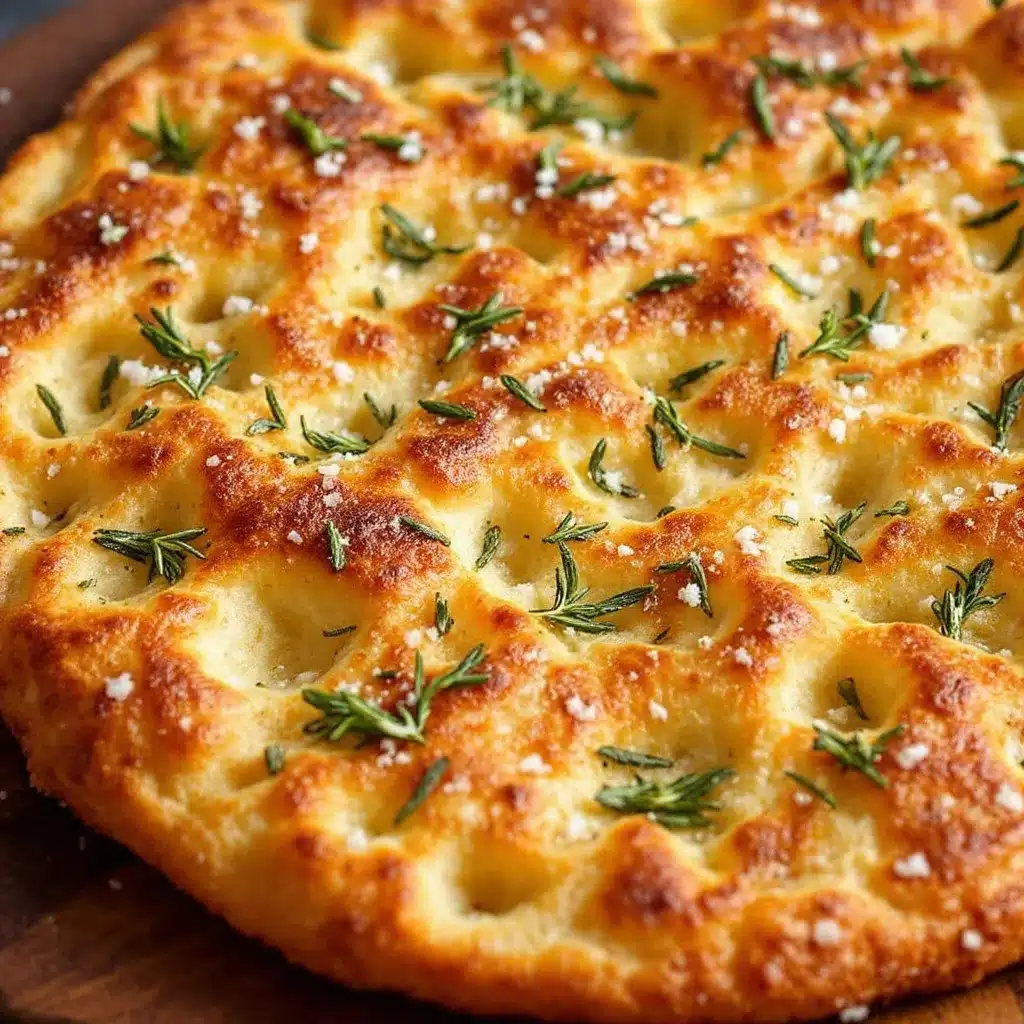
You know that feeling when a recipe finally clicks? When you stop following instructions like a robot and actually understand what the dough is telling you? That’s what this crispy sourdough focaccia with rosemary and sea salt taught me. It’s not complicated once you know the rhythm. And maybe you’ve been there — staring at a sad, flat focaccia wondering where you went wrong. Let me tell you, I’ve made every mistake in the book so you don’t have to. This recipe is the one that finally made me feel like a real bread baker, and I keep making it because it never gets old. That first crackle of the crust, the way the rosemary smells as it hits the hot oil, the flaky salt crystals catching the light — it’s pure kitchen magic.
Why You’ll Love This Recipe
Let me be real with you — there are a thousand focaccia recipes on the internet, and most of them are fine. But this one? This one is different. I’ve tested this crispy sourdough focaccia with rosemary and sea salt at least fifteen times across three different ovens, two different starters, and one particularly humid summer that nearly drove me crazy. What I landed on is a method that works every single time, no matter your kitchen setup. It’s not just another bread recipe — it’s the one that will make you stop buying bakery focaccia forever.
- Unbelievably Crispy Crust : That shatteringly crisp bottom and golden top that makes store-bought focaccia look sad in comparison. The secret is a cold fermentation technique that builds flavor and structure simultaneously.
- Simple Ingredients : You need flour, water, salt, olive oil, rosemary, and your sourdough starter. That’s it. No yeast packets, no specialty flours, no trips to three different stores.
- Perfect for Any Occasion : Serve it alongside soup on a cold night, slice it up for a fancy brunch spread, or just eat it straight off the counter while no one is watching (I won’t tell).
- Crowd-Pleaser : I brought this to a potluck last month and three people asked for the recipe before I’d even put the lid back on my container. Kids love the salt crystals, adults love the herbaceous rosemary, and everyone loves the crunch.
- Next-Level Comfort Food : There’s something deeply satisfying about making bread from scratch, and this crispy sourdough focaccia with rosemary and sea salt delivers that warm, accomplished feeling with every batch.
What makes this recipe different from all the others? It’s the technique — specifically the way we handle the dough during its long, cold rise. Most recipes rush the process or skip the crucial stretching steps that develop that signature focaccia texture. I’ve also dialed in the exact oil-to-dough ratio that gives you a golden, almost fried bottom crust without making the bread greasy. And the rosemary? I’ve tested fresh versus dried, whole leaves versus chopped, and I’ll share exactly what works best.
This isn’t just good bread — it’s the kind that makes you close your eyes after the first bite. The kind where you hear yourself make a sound you didn’t know you could make over bread. It’s comfort food reimagined — simpler than you think, but with the same soul-soothing satisfaction that made you fall in love with homemade bread in the first place. Perfect for impressing dinner guests without spending all day in the kitchen, or for turning a Tuesday night into something that feels special.
What Ingredients You Will Need
This crispy sourdough focaccia with rosemary and sea salt uses simple, wholesome ingredients that work together to create something far greater than the sum of their parts. Most of these are pantry staples for anyone who keeps a sourdough starter, and the fresh ingredients are easy to find at any grocery store.
For the Dough
- 500 grams (3 ¾ cups) bread flour — I prefer King Arthur Bread Flour for its higher protein content, which gives the focaccia better structure and that signature chew. All-purpose flour works in a pinch, but the texture won’t be quite as airy.
- 375 grams (1 ½ cups) lukewarm water — About 80°F (27°C). Too hot will kill your starter’s activity, too cold will slow the fermentation. I use filtered water because chlorine can affect sourdough fermentation.
- 150 grams (¾ cup) active sourdough starter — Make sure it’s bubbly and doubled in size before you start. A hungry, flat starter will give you dense bread with no rise. I feed mine the night before I plan to bake.
- 10 grams (2 teaspoons) fine sea salt — I use Redmond Real Salt or Maldon sea salt for the dough itself. Table salt works but reduce to 8 grams since it’s more concentrated.
- 30 grams (2 tablespoons) extra-virgin olive oil — For the dough. Use a good quality oil here since you’ll taste it. I like California Olive Ranch for a balanced, fruity flavor that doesn’t overpower the rosemary.
For the Topping
- 60 grams (¼ cup) extra-virgin olive oil — This goes into the pan and gets drizzled on top. Don’t skimp here — the oil is what creates that crispy, golden bottom crust.
- 2 tablespoons fresh rosemary, finely chopped — I grow my own, but grocery store rosemary works beautifully. Dried rosemary can be used in a pinch, but use half the amount and rub it between your palms to release the oils.
- 1 ½ teaspoons flaky sea salt — Maldon flaky sea salt is my go-to for finishing. The big, delicate crystals provide little bursts of salt that contrast perfectly with the rich olive oil and fragrant rosemary.
- Optional: 2 cloves garlic, thinly sliced — I sometimes press garlic slivers into the dough before the final proof for a garlic-rosemary combo that’s absolutely addictive.
Ingredient Selection Tips: Look for rosemary that’s bright green and fragrant, not woody or dried out. If your rosemary is looking sad, you can revive it by trimming the stems and placing them in a glass of water for an hour. For the flaky salt, avoid anything labeled “fine” — you want those big, visible crystals that provide texture and visual appeal. I’ve tried this recipe with pink Himalayan salt and it works, but the flavor is slightly different — more mineral, less clean.
Substitution Guidance: For a whole wheat version, swap up to 200 grams of the bread flour with whole wheat flour. The texture will be denser but the flavor will be nuttier and more complex. Gluten-free bakers can try a 1:1 gluten-free flour blend, but I’ll be honest — the texture won’t be the same. For a dairy-free version, you’re already good since this recipe contains no dairy. If you don’t have a sourdough starter, you can use 1 teaspoon of active dry yeast dissolved in the lukewarm water, but let the dough rise at room temperature for 4-6 hours instead of the cold fermentation.
Equipment Needed
You don’t need a fancy bakery setup to make this crispy sourdough focaccia with rosemary and sea salt. Here’s what you’ll actually use:
- 10×15-inch rimmed baking sheet — This is the goldilocks size for focaccia. Too small and the bread will be too thick and doughy; too large and it will spread too thin. I use a Nordic Ware half-sheet pan that I’ve had for years.
- Digital kitchen scale — Honestly, this is non-negotiable for sourdough baking. Measuring flour by volume is wildly inconsistent, and 500 grams of flour can vary by 100 grams depending on how you scoop it. I use an OXO scale that cost me $20 and it’s still going strong.
- Large mixing bowl — Glass or ceramic works best since they don’t retain heat. I use a 4-quart Pyrex bowl that lets me see the dough’s activity through the sides.
- Bench scraper — This $5 tool is worth its weight in gold for folding and dividing dough. A plastic dough scraper also works.
- Plastic wrap or a reusable bowl cover — To keep the dough from drying out during its long fermentation.
- Small saucepan — For warming the olive oil and rosemary together. This step is optional but recommended.
- Cooling rack — Essential for keeping that bottom crust crispy. If you let the focaccia cool in the pan, the steam will soften the crust.
Budget-Friendly Options: Don’t have a digital scale? You can use the spoon-and-level method for flour, but I really recommend investing in one — it will improve every baked good you make. No rimmed baking sheet? A 9×13-inch cake pan works, though the bread will be thicker and may need an extra 5-10 minutes of baking time. No cooling rack? Carefully tip the focaccia on its edge and prop it up with a wooden spoon to let air circulate underneath.
Preparation Method
This process takes about 24 hours from start to finish, but don’t let that scare you — most of that time is hands-off fermentation. The active work is maybe 30 minutes total.
Day 1: Make the Dough
- Mix the dough (10 minutes): In your large mixing bowl, combine 375 grams lukewarm water and 150 grams active sourdough starter. Stir until the starter is mostly dissolved — a few small clumps are fine. Add 500 grams bread flour and 30 grams olive oil. Mix with your hands or a dough whisk until no dry flour remains. The dough will be shaggy and sticky — this is normal. Cover the bowl with plastic wrap and let it rest for 30 minutes. This rest period, called autolyse, lets the flour absorb the water and makes the dough easier to work with.
- Add the salt (5 minutes): Sprinkle 10 grams fine sea salt over the dough. Wet your hands with a little water to prevent sticking, then fold the dough over itself several times until the salt is incorporated. The dough will feel smoother and more elastic after this step. Cover and let rest for 30 minutes.
- Perform the first set of stretches (5 minutes): Wet your hands again. Grab one corner of the dough, stretch it up and fold it over the center. Rotate the bowl 90 degrees and repeat. Do this four times total, working your way around the bowl. The dough will resist at first but will start to relax. Cover and let rest 30 minutes.
- Second set of stretches (5 minutes): Repeat the same stretching and folding process. By now, the dough should feel noticeably smoother and more structured. You’ll see bubbles forming along the surface. Cover and let rest 30 minutes.
- Third set of stretches (5 minutes): One more round of stretches. The dough should now be silky and elastic, pulling away from the bowl cleanly. Cover the bowl tightly with plastic wrap and place it in the refrigerator for 12-18 hours. This cold fermentation develops flavor and makes the dough easier to handle.
Day 2: Shape and Bake
- Prepare the pan (5 minutes): The next morning, pour 60 grams olive oil into your 10×15-inch baking sheet. Use your fingers to spread it evenly across the bottom and up the sides. The oil should pool slightly — this is what creates that crispy bottom crust.
- Transfer the dough (5 minutes): Remove the dough from the refrigerator. It should be puffy, bubbly, and smell pleasantly sour. Use a bench scraper to gently coax the dough out of the bowl and into the oiled pan. Don’t deflate it more than necessary. Let the dough rest uncovered for 15 minutes to relax.
- Stretch the dough (10 minutes): This is the fun part. With oiled fingers, gently stretch the dough toward the edges of the pan. It will resist and try to spring back — that’s okay. Let it rest for 10 minutes, then stretch again. Repeat this process 3-4 times until the dough fills the pan evenly. If it keeps shrinking back, it needs more rest time. Be patient — rushing this step leads to uneven focaccia.
- Dimple the dough (5 minutes): Once the dough fills the pan, oil your fingers generously and press straight down into the dough, creating deep dimples across the entire surface. Don’t be shy — you want those wells to hold the oil and rosemary. I do about 20-25 dimples across the surface.
- Add the toppings (5 minutes): In a small saucepan, gently warm 2 tablespoons of olive oil with 2 tablespoons chopped fresh rosemary over low heat for 2-3 minutes. This infuses the oil with rosemary flavor. Drizzle this mixture over the dimpled dough, making sure the oil pools in the dimples. Sprinkle 1 ½ teaspoons flaky sea salt evenly across the top. If using garlic slivers, press them into the dimples now.
- Final proof (2-3 hours): Cover the pan loosely with plastic wrap and let the dough rise at room temperature until it’s puffy and jiggly, almost like a marshmallow. The time depends on your kitchen temperature — warmer kitchens will be faster. You’ll know it’s ready when the dough has risen by about 50% and small bubbles are visible on the surface.
- Preheat the oven (30 minutes): About 30 minutes before baking, place a rack in the lower third of your oven and preheat to 450°F (232°C). If you have a baking stone or steel, place it on the rack to preheat — this helps create an even crisper bottom crust.
- Bake the focaccia (25-30 minutes): Place the pan on the preheated baking stone or directly on the oven rack. Bake for 25-30 minutes, rotating the pan halfway through. The focaccia is done when the top is deep golden brown and the bottom sounds hollow when tapped. If the top is browning too quickly, tent loosely with foil for the last 10 minutes.
- Cool (10 minutes): Remove the pan from the oven and let it cool for 5 minutes. Then use a spatula to transfer the focaccia to a cooling rack. Don’t let it cool in the pan — the trapped steam will soften that beautiful crispy crust. Let it cool for at least 10 minutes before slicing, though I know it’s hard to wait.
Cooking Tips & Techniques
After about fifteen batches of this crispy sourdough focaccia with rosemary and sea salt, I’ve learned a few things the hard way. Here are the tips that made the biggest difference.
The cold fermentation is non-negotiable. I tried rushing the process once — only refrigerated the dough for 6 hours instead of 12 — and the difference was dramatic. The short-fermented focaccia was flat, dense, and lacked that complex sourdough tang. The long, cold rise develops flavor compounds that you simply can’t get any other way. Plan ahead and give it the full 12-18 hours.
Watch your water temperature carefully. I made the mistake of using warm tap water one time and my dough was over-fermented and sticky by morning. Use a thermometer — 80°F (27°C) is the sweet spot. Too cold and the fermentation will be sluggish; too warm and you’ll wake up to a bowl of sourdough soup.
The dimpling technique matters more than you think. I used to just poke a few random holes and call it done. But those dimples aren’t just decorative — they create pockets that hold the olive oil and rosemary, which then caramelize during baking and create those crispy, flavorful spots. Press firmly and evenly, spacing them about an inch apart. You want the dough to almost look like a golf ball surface.
Don’t skip the oil warming step. I used to just drizzle cold oil over the dough and sprinkle rosemary on top. The rosemary would burn in the oven while the oil stayed separate. Warming the oil with the rosemary infuses the flavor throughout, and the warm oil spreads more evenly across the dough. Trust me on this one — it’s a game-changer.
My biggest failure: The time I forgot to oil the pan properly. I was distracted by a phone call and only gave it a quick spray of cooking spray. The focaccia stuck to the pan like cement, and I ended up with a pile of crispy crumbs instead of a beautiful sheet of bread. Don’t be me — use enough oil to coat the pan generously. The oil is what creates that golden, crispy bottom crust, and it also ensures your bread releases cleanly.
Multitasking tip: While the dough is doing its final proof, prep your toppings and get your oven preheated. I also use this time to clean up my workspace and set up my cooling rack. That way, when the bread comes out of the oven, I’m ready to transfer it immediately without scrambling.
Variations & Adaptations
One of the best things about this crispy sourdough focaccia with rosemary and sea salt is how adaptable it is. Here are some variations I’ve tried and loved.
Herb Garden Focaccia: Swap the rosemary for a mix of fresh thyme, oregano, and sage. I did this one summer when my herb garden was overflowing, and the combination was incredible — earthy, aromatic, and perfect with roasted vegetables. Use about 3 tablespoons total of mixed herbs, chopped fine.
Everything Bagel Focaccia: After dimpling and oiling, sprinkle the dough with 2 tablespoons of everything bagel seasoning (sesame seeds, poppy seeds, dried garlic, dried onion, and salt). My kids go crazy for this version — it’s like a bagel and focaccia had a beautiful baby. Bake as directed.
Roasted Garlic and Caramelized Onion: Before adding the dough to the pan, scatter 1 cup of caramelized onions and 6-8 roasted garlic cloves across the bottom. The onions get crispy and sweet during baking, and the garlic becomes spreadably soft. This version is incredible alongside a hearty stew or braised meat.
Gluten-Free Adaptation: I tested this with a 1:1 gluten-free flour blend (Cup4Cup works well) and it actually turned out surprisingly good. The texture is more cake-like and less airy, but the crispy bottom and herby top still deliver. Reduce the water to 350 grams since gluten-free flours absorb less liquid. The cold fermentation isn’t necessary for gluten-free — just let it rise at room temperature for 4 hours.
Whole Wheat Version: Replace 200 grams of bread flour with whole wheat flour. The dough will be less extensible and the final bread will be denser, but the nutty, earthy flavor is worth it. Add an extra 25 grams of water since whole wheat flour absorbs more liquid.
Serving & Storage Suggestions
This crispy sourdough focaccia with rosemary and sea salt is best served warm, but it’s still delicious at room temperature. The ideal serving temperature is about 10 minutes after it comes out of the oven — the crust is still crackly but the interior has set enough to slice cleanly.
Serving Ideas: Slice it into squares or strips and serve alongside a bowl of tomato soup or minestrone for the ultimate comfort meal. It’s also fantastic split horizontally and used for sandwiches — try it with prosciutto, fresh mozzarella, and a drizzle of balsamic glaze. For brunch, serve it with scrambled eggs, roasted tomatoes, and a simple arugula salad. Honestly, I’ve also eaten it plain, standing over the counter, and it was perfect.
Storage: Store leftover focaccia in an airtight container at room temperature for up to 3 days. Do not refrigerate — the cold will dry out the bread and make the crust rubbery. If you need to store it longer, freeze it.
Freezing: Wrap the cooled focaccia tightly in plastic wrap, then in aluminum foil, and freeze for up to 3 months. To reheat, unwrap and place directly on the oven rack at 350°F (175°C) for 10-15 minutes. The crust will crisp back up beautifully. I often make a double batch and freeze one for later — it’s a lifesaver for busy weeks.
Reheating: The microwave will make the focaccia soggy, so avoid it. Instead, reheat slices in a toaster oven or under the broiler for 2-3 minutes. For a whole sheet, place it back in the pan and warm in a 350°F oven for 10 minutes.
Flavor Development: Here’s something interesting — the flavor actually improves on day two. The rosemary and olive oil continue to meld, and the sourdough tang becomes more pronounced. If you can resist eating it all on day one, you’re in for a treat on day two.
Nutritional Information & Benefits
While I wouldn’t call focaccia a health food, this crispy sourdough focaccia with rosemary and sea salt does have some redeeming qualities. Here’s the estimated nutrition per serving (based on 12 servings):
- Calories: 220
- Total Fat: 10g
- Saturated Fat: 1.5g
- Carbohydrates: 28g
- Fiber: 1g
- Protein: 5g
- Sodium: 380mg
Health Benefits: Sourdough fermentation breaks down phytic acid in the flour, making the minerals more bioavailable. This means your body can actually absorb more of the nutrients from the bread. The olive oil provides heart-healthy monounsaturated fats, and rosemary is rich in antioxidants and anti-inflammatory compounds. Plus, the slow fermentation process creates a lower glycemic index compared to bread made with commercial yeast, which means steadier blood sugar levels.
Dietary Considerations: This recipe is naturally dairy-free, egg-free, and vegan. It contains gluten, so it’s not suitable for celiac disease or gluten sensitivity (unless you use the gluten-free adaptation). The sodium content is moderate — you can reduce the flaky salt topping if you’re watching your salt intake, though it will affect the texture and flavor.
I personally love that this bread feels indulgent but isn’t packed with the processed ingredients you find in store-bought options. It’s real food made from real ingredients, and there’s something deeply satisfying about that.
FAQs
Why is my focaccia not crispy?
The most common reason is not using enough oil in the pan. That generous pool of olive oil is what creates the crispy bottom crust. Also, make sure you’re cooling the focaccia on a wire rack, not in the pan. Trapped steam will soften the crust every time. Finally, check your oven temperature — if it’s not hot enough, the bread will bake slowly and steam out rather than crisping up.
Can I use dried rosemary instead of fresh?
Yes, but use half the amount (1 tablespoon dried for 2 tablespoons fresh). Rub the dried rosemary between your palms before adding it to release the oils. The flavor won’t be quite as bright, but it still works well. I actually prefer fresh rosemary in this recipe because it stays more aromatic during the long bake time.
My dough is too sticky to handle. What am I doing wrong?
Sourdough focaccia dough is supposed to be sticky — that’s normal! The key is to wet your hands or oil them before handling the dough. Don’t be tempted to add extra flour, which will make the bread dense. If the dough is truly unmanageable (like soup-level sticky), your hydration might be off. Next time, reduce the water by 25 grams and see if that helps.
How do I know when my sourdough starter is ready to use?
Your starter should be bubbly, doubled in size, and smell pleasantly sour — like yogurt or ripe fruit. It should pass the “float test”: drop a small spoonful into a glass of water and if it floats, it’s ready. If it sinks, it needs more time to ferment. I feed my starter the night before I plan to bake, using a 1:1:1 ratio (starter:flour:water).
Can I make this recipe without a sourdough starter?
Absolutely. Replace the 150 grams of sourdough starter with 75 grams of water and 75 grams of flour (so total flour becomes 575 grams and total water becomes 450 grams). Add 1 teaspoon of active dry yeast to the lukewarm water and let it sit for 5 minutes until foamy. Skip the cold fermentation and let the dough rise at room temperature for 4-6 hours instead. The flavor won’t have that sourdough tang, but it will still be delicious and crispy.
Conclusion
This crispy sourdough focaccia with rosemary and sea salt has become my signature bread — the one I bring to gatherings, the one friends request for holidays, the one that makes me feel like a real baker every single time. It took me months of trial and error to get here, but now that I have, I can’t imagine going back to the sad, flat focaccia of my past. The secret, as my neighbor Grace taught me, is confidence — being willing to handle the dough firmly, to trust the process, and to give it the time it needs.
What I love most about this recipe is how forgiving it is once you understand the rhythm. It’s not about perfection — it’s about the joy of making something beautiful and delicious with your own hands. Whether you’re a seasoned sourdough baker or someone who’s never made bread before, this recipe will work for you. The crispy crust, the fragrant rosemary, the satisfying crackle when you bite into it — it’s all worth the 24-hour wait.
Now I want to hear from you! Have you tried making focaccia before? What’s your favorite topping combination? Drop a comment below and let me know how your crispy sourdough focaccia with rosemary and sea salt turned out. And if you loved this recipe, share it with a friend who needs a little bread therapy in their life. Happy baking, friends!
Pin This Recipe!

Easy Crispy Sourdough Focaccia with Rosemary & Sea Salt

This crispy sourdough focaccia with rosemary and sea salt features a shatteringly crisp crust and airy interior, thanks to a cold fermentation technique. Made with simple ingredients and a confident handling method, it’s the perfect bread for any occasion.
- Prep Time: 30 minutes
- Cook Time: 25-30 minutes
- Total Time: 24 hours (including 12-18 hours cold fermentation and 2-3 hours final proof)
- Yield: 12 servings 1x
- Category: Bread
- Cuisine: Italian
Ingredients
- 500 grams (3 ¾ cups) bread flour
- 375 grams (1 ½ cups) lukewarm water (80°F / 27°C)
- 150 grams (¾ cup) active sourdough starter
- 10 grams (2 teaspoons) fine sea salt
- 30 grams (2 tablespoons) extra-virgin olive oil (for dough)
- 60 grams (¼ cup) extra-virgin olive oil (for pan and topping)
- 2 tablespoons fresh rosemary, finely chopped
- 1 ½ teaspoons flaky sea salt (e.g., Maldon)
- Optional: 2 cloves garlic, thinly sliced
Instructions
- Mix the dough: In a large bowl, combine 375 grams lukewarm water and 150 grams active sourdough starter. Stir until mostly dissolved. Add 500 grams bread flour and 30 grams olive oil. Mix until no dry flour remains. Cover and rest for 30 minutes (autolyse).
- Add the salt: Sprinkle 10 grams fine sea salt over the dough. Wet your hands and fold the dough over itself several times until salt is incorporated. Cover and rest 30 minutes.
- First set of stretches: Wet your hands. Grab one corner of the dough, stretch it up, and fold it over the center. Rotate the bowl 90 degrees and repeat for a total of 4 folds. Cover and rest 30 minutes.
- Second set of stretches: Repeat the stretching and folding process. Cover and rest 30 minutes.
- Third set of stretches: Repeat one more round of stretches. Cover tightly with plastic wrap and refrigerate for 12-18 hours (cold fermentation).
- Prepare the pan: The next morning, pour 60 grams olive oil into a 10×15-inch rimmed baking sheet. Spread evenly across the bottom and up the sides.
- Transfer the dough: Remove dough from refrigerator. Gently coax it into the oiled pan using a bench scraper. Let rest uncovered for 15 minutes.
- Stretch the dough: With oiled fingers, gently stretch the dough toward the edges of the pan. Let rest 10 minutes, then stretch again. Repeat 3-4 times until dough fills the pan evenly.
- Dimple the dough: Oil your fingers and press straight down into the dough, creating deep dimples across the entire surface (about 20-25 dimples).
- Add the toppings: In a small saucepan, gently warm 2 tablespoons olive oil with 2 tablespoons chopped fresh rosemary over low heat for 2-3 minutes. Drizzle over the dimpled dough. Sprinkle 1 ½ teaspoons flaky sea salt evenly. If using garlic slivers, press them into the dimples.
- Final proof: Cover pan loosely with plastic wrap and let rise at room temperature for 2-3 hours until puffy and jiggly (risen by about 50%).
- Preheat the oven: About 30 minutes before baking, place a rack in the lower third of the oven and preheat to 450°F (232°C). Optionally, preheat a baking stone or steel.
- Bake the focaccia: Place the pan on the preheated stone or rack. Bake for 25-30 minutes, rotating halfway through, until deep golden brown and bottom sounds hollow when tapped. Tent with foil if browning too quickly.
- Cool: Remove from oven and let cool in pan for 5 minutes. Transfer to a cooling rack using a spatula. Cool for at least 10 minutes before slicing.
Notes
The cold fermentation is non-negotiable for best flavor and texture. Use a thermometer to ensure water is at 80°F (27°C). Don’t skip the oil warming step—it infuses the rosemary flavor. For a gluten-free version, use a 1:1 gluten-free flour blend and reduce water to 350 grams; skip cold fermentation and let rise at room temperature for 4 hours. Store leftovers at room temperature for up to 3 days; freeze for up to 3 months. Reheat in a 350°F oven for 10 minutes to restore crispiness.
Nutrition
- Serving Size: 1 slice (1/12 of rec
- Calories: 220
- Sodium: 380
- Fat: 10
- Saturated Fat: 1.5
- Carbohydrates: 28
- Fiber: 1
- Protein: 5
Keywords: sourdough focaccia, crispy focaccia, rosemary focaccia, sea salt focaccia, homemade bread, sourdough bread, easy focaccia recipe