Love this? Save it for later!
Share the inspiration with your friends
Let me be honest with you—I spent years thinking prime rib was something you only ordered at a fancy steakhouse. The kind of meal reserved for anniversaries or when someone else was paying the bill. The idea of making it at home felt intimidating, maybe even a little foolish. I mean, what if I messed up an expensive cut of meat right before a house full of hungry guests?
But here’s the thing about Game Day cooking. You want something that feels like an event. Something that makes people stop mid-sentence when you bring it to the table. And honestly, nothing does that quite like a perfectly cooked prime rib roast with garlic herb butter melting down the sides.
I remember the first time I attempted this. It was a chilly Sunday in January, and I had invited a few friends over for the playoffs. I’d spent the whole week psyching myself up, watching videos, reading every tip I could find. And you know what? It worked. The roast came out gorgeous—crimson in the center, deeply browned on the outside, with that garlic butter crust that everyone couldn’t stop talking about. My buddy Mark, who claims he “doesn’t do red meat,” asked for seconds. Then thirds.
So maybe you’ve been there. Standing in the grocery aisle, eyeing that beautiful roast, wondering if you’ve got what it takes to pull it off. I’m here to tell you—you absolutely do. This recipe is built for confidence. It’s forgiving, it’s impressive, and it tastes like you spent all day in the kitchen when really, the oven does most of the work.
This is the kind of meal that turns a regular game day into something people talk about for years. And honestly? That’s exactly why I keep making it.
Why You’ll Love This Recipe
This isn’t just another roast beef recipe. This is the one that’ll have your guests hovering around the kitchen island, asking what you did differently. And the best part? It’s way easier than you think.
- Foolproof Method: The low-and-slow roasting technique with a final high-heat sear gives you perfect doneness every time. No guesswork, no stress.
- Simple Ingredients: You don’t need a specialty butcher or imported butter. Good quality beef, fresh herbs, garlic, and salt—that’s it.
- Perfect for Game Day: This roast feeds a crowd without you being stuck in the kitchen. Pop it in the oven, then go enjoy the pre-game show.
- Next-Level Flavor: The garlic herb butter does something magical here. It seeps into every crevice, creating a crust that’s crispy, savory, and utterly addictive.
- Impressive Without the Pressure: This looks like a million bucks on a platter, but the recipe is designed to take the intimidation out of cooking a large roast.
What makes this version different from every other prime rib recipe out there? It’s the butter. Not just any butter—a generous layer of compound butter packed with fresh rosemary, thyme, and roasted garlic. You slather it on the night before, letting it work its magic while you sleep. The result is a roast that’s seasoned from the inside out, with a crust that shatters when you slice it.
This is the recipe I turn to when I want to feed people something they’ll remember. It’s comfort food at its most elegant, and it never fails to make me look like I know what I’m doing—even on days when I definitely don’t.
What Ingredients You Will Need
This recipe relies on a handful of quality ingredients, each playing a specific role in building flavor and texture. Here’s what you’ll need and why each one matters.
For the Prime Rib Roast
- 1 (6-8 pound) bone-in prime rib roast: Bone-in is the way to go here. The bones act as a natural roasting rack, add flavor, and help the meat cook more evenly. Look for a roast with good marbling—those thin streaks of fat running through the meat are what keep it juicy. I usually buy mine from Costco or a local butcher I trust.
- 1 tablespoon kosher salt: Don’t skimp here. Kosher salt is less dense than table salt, so you need more of it to properly season a large roast. I use Diamond Crystal brand for its consistent texture.
- 1 teaspoon freshly ground black pepper: Freshly ground makes a noticeable difference. Pre-ground pepper just doesn’t have the same punch.
For the Garlic Herb Butter
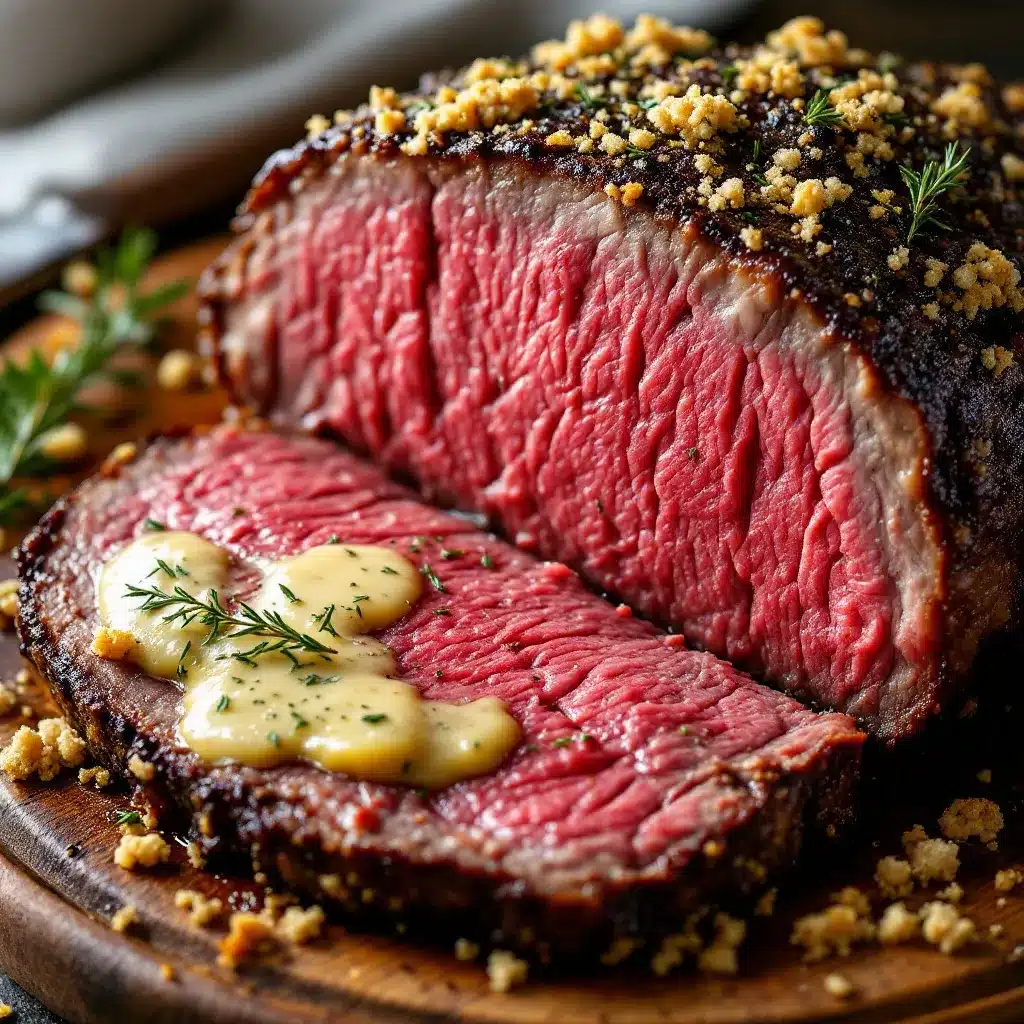
- 1/2 cup unsalted butter, softened: Let it sit out for about 30 minutes. You want it soft enough to spread easily but not melted. Kerrygold is my go-to for its rich, grassy flavor.
- 6 cloves garlic, minced: Fresh garlic is non-negotiable here. The jarred stuff won’t give you the same punch. I like to let the minced garlic sit for a few minutes before mixing it in—this helps release more flavor compounds.
- 2 tablespoons fresh rosemary, finely chopped: Rosemary and beef are a classic pair. The piney, slightly floral notes cut through the richness of the meat.
- 2 tablespoons fresh thyme leaves: Thyme adds an earthy, slightly lemony undertone. Strip the leaves from the stems—the stems are too tough to eat.
- 1 tablespoon fresh parsley, chopped: Parsley adds freshness and a bright green color to the butter. It’s mostly for looks, but it also adds a subtle herbaceous note.
- 1 teaspoon flaky sea salt: Maldon salt is my favorite here. The large, delicate flakes add little bursts of saltiness that pop on your tongue.
- 1/2 teaspoon red pepper flakes (optional): A tiny bit of heat wakes up all the other flavors. Leave it out if you’re sensitive to spice.
For the Au Jus (Optional but Recommended)
- 1 cup beef broth: Use a good quality broth—I like Better Than Bouillon paste mixed with water for its deep flavor.
- 1/4 cup dry red wine: Something drinkable, like a Cabernet Sauvignon or Merlot. The alcohol cooks off, leaving behind rich, fruity notes.
- 1 tablespoon all-purpose flour: This thickens the jus just enough to coat the back of a spoon.
- Pan drippings from the roast: This is where all the flavor lives. Don’t skip this.
Equipment Needed
You don’t need a professional kitchen to pull this off, but a few key tools will make the process smoother.
- Roasting pan with a rack: A sturdy pan is essential for catching drippings and keeping the roast elevated. If you don’t have a rack, you can use rolled-up aluminum foil to lift the roast.
- Instant-read meat thermometer: This is your most important tool. Guessing doneness on a large roast is a recipe for disaster. I use a Thermapen—it reads in about 2 seconds and has never let me down.
- Chef’s knife: A sharp knife makes slicing the roast clean and easy. Dull knives will shred the meat.
- Kitchen twine: Tying the roast helps it cook evenly and hold its shape. You can skip this if your roast is already tied by the butcher.
- Aluminum foil: You’ll need this for resting the roast after it comes out of the oven.
- Small saucepan: For making the au jus.
- Mixing bowl: For combining the garlic herb butter.
If you don’t have a roasting rack, don’t worry. I’ve used a makeshift rack of carrots and celery before—it works great and adds extra flavor to the drippings.
Preparation Method
This is where the magic happens. Follow these steps carefully, and you’ll have a roast that looks like it came from a steakhouse.
- Take the chill off the roast (1 hour before cooking): Remove the prime rib from the refrigerator and let it sit at room temperature for about 1 hour. This step is crucial—a cold roast will cook unevenly, leaving you with a raw center and overcooked edges. Pat the roast dry with paper towels. Moisture is the enemy of a good crust.
- Make the garlic herb butter (15 minutes): In a small bowl, combine the softened butter, minced garlic, chopped rosemary, thyme, parsley, flaky sea salt, and red pepper flakes (if using). Mash everything together with a fork until it’s well combined and looks like a rustic compound butter. Set aside at room temperature.
- Season the roast (5 minutes): Rub the entire surface of the roast with the kosher salt and black pepper. Don’t be shy—you want a good coating. Then, using your hands, generously spread the garlic herb butter all over the roast, covering every inch. Don’t forget the ends. If you have time, wrap the roast in plastic wrap and refrigerate overnight. This dry-brine effect seasons the meat more deeply.
- Preheat the oven (20 minutes): Position a rack in the lower third of your oven and preheat to 450°F (232°C). You want the oven screaming hot for the initial sear.
- Roast at high heat (15 minutes): Place the roast bone-side down on the rack in your roasting pan. Roast at 450°F for 15 minutes. This high-heat blast creates that beautiful brown crust. Don’t open the oven door during this time—you’ll lose all the heat.
- Lower the heat and continue roasting (2-2.5 hours): Reduce the oven temperature to 325°F (163°C). Continue roasting until the internal temperature reaches 120°F (49°C) for rare, 125°F (52°C) for medium-rare, or 130°F (54°C) for medium. Insert your thermometer into the thickest part of the meat, avoiding the bone. Start checking the temperature about 30 minutes before you think it’ll be done. Every oven is different, and it’s better to check early than to overcook.
- Rest the roast (20-30 minutes): This step is non-negotiable. Remove the roast from the oven and transfer it to a cutting board. Tent loosely with aluminum foil and let it rest for at least 20 minutes. During this time, the temperature will rise by 5-10 degrees (carryover cooking), and the juices will redistribute throughout the meat. If you skip this, all those beautiful juices will end up on your cutting board instead of in your mouth.
- Make the au jus (10 minutes, while the roast rests): Place the roasting pan on the stovetop over medium heat. Add the beef broth and red wine, scraping up any browned bits from the bottom of the pan. Whisk in the flour and let it simmer for 3-4 minutes until thickened slightly. Strain through a fine-mesh sieve if you want a smooth jus. Taste and adjust seasoning with salt and pepper.
- Slice and serve (5 minutes): Remove the kitchen twine. Using a sharp chef’s knife, slice between the bones to separate them from the roast. Then slice the meat against the grain into 1/2-inch thick slices. Arrange on a platter, spoon some au jus over the top, and serve immediately.
Cooking Tips & Techniques
I’ve made this recipe more times than I can count, and I’ve learned a few things along the way. Here are my best tips for success.
Don’t skip the overnight dry brine. If you have the time, seasoning the roast with salt and the garlic herb butter the night before makes a huge difference. The salt penetrates deep into the meat, seasoning it from the inside out. Plus, the butter helps create an even better crust. I learned this after making a roast that was perfectly cooked but somehow tasted bland. The dry brine fixed everything.
Use a thermometer, not your instincts. I know, I know—everyone thinks they can tell doneness by poking the meat or checking the color. But on a large roast, you’re guessing. An instant-read thermometer takes the guesswork out. I’ve had roasts that looked done on the outside but were still cold in the center. Trust the thermometer.
Let the meat rest, no exceptions. I once got impatient and sliced into a roast right after it came out of the oven. The result was a pool of juices on the cutting board and dry, disappointing meat. Resting allows the juices to redistribute. Twenty minutes feels like an eternity when everyone’s hungry, but it’s worth it.
Watch your oven temperature. Ovens run hot or cold, and they don’t always tell the truth. I use an oven thermometer to double-check. You’d be surprised how many ovens are off by 25 degrees or more.
Don’t overcrowd the roasting pan. If you’re making a smaller roast, use a smaller pan. Too much empty space in the pan can cause the drippings to burn. You want just enough room for the roast and a little space around it.
Variations & Adaptations
This recipe is flexible. Here are a few ways to make it your own.
Herb Swap: Not a fan of rosemary? Try using tarragon or oregano instead. Tarragon has a subtle licorice flavor that pairs beautifully with beef. I made this swap once when I ran out of rosemary, and honestly, I might like it better.
Spicy Version: Add 1 tablespoon of Dijon mustard to the garlic herb butter for a tangy, spicy kick. Or mix in a teaspoon of smoked paprika for a deeper, smokier flavor. My brother-in-law loves this version—he says it reminds him of barbecue.
Dairy-Free Adaptation: Substitute the butter with a high-quality vegan butter or olive oil. Use 1/4 cup of olive oil mixed with the herbs and garlic. The crust won’t be quite as crispy, but the flavor is still fantastic.
Different Roast Sizes: This recipe scales up or down easily. For a smaller roast (3-4 pounds), reduce the initial high-heat sear to 10 minutes and check the temperature earlier. For a larger roast (8-10 pounds), add 10-15 minutes to the initial sear and expect a longer cooking time.
Grill Method: If the weather cooperates, you can cook this on a grill. Set up your grill for indirect heat at 325°F. Sear the roast over direct heat for 5 minutes per side, then move to the indirect side and cook until it reaches your desired temperature. The smoky flavor is incredible.
Serving & Storage Suggestions
Prime rib is a showstopper, but how you serve and store it matters.
Serving: Serve the roast warm, sliced against the grain into 1/2-inch thick pieces. Arrange on a large platter with the separated ribs on the side—someone will want to gnaw on those. Spoon a little au jus over the top and serve the rest on the side. I like to add a sprinkle of flaky sea salt and fresh cracked pepper right before serving for a final touch.
What to Serve With It: This roast pairs beautifully with creamy mashed potatoes, roasted vegetables (especially asparagus or Brussels sprouts), and a simple arugula salad with lemon vinaigrette. For Game Day, I also like to serve it with crusty bread and horseradish cream on the side.
Storage: Leftover prime rib is a gift. Store slices in an airtight container in the refrigerator for up to 4 days. The flavors actually deepen overnight—I often think leftovers taste even better the next day.
Reheating: The key to reheating is to do it gently. Place slices in a baking dish with a splash of beef broth, cover with foil, and warm in a 300°F oven for 10-15 minutes. Avoid the microwave—it’ll turn your beautiful roast into shoe leather.
Freezing: You can freeze cooked prime rib for up to 3 months. Wrap slices tightly in plastic wrap, then foil, and place in a freezer bag. Thaw overnight in the refrigerator before reheating.
Nutritional Information & Benefits
Prime rib is an indulgence, but it also has some nutritional benefits worth noting.
Estimated Nutrition Per Serving (6 oz serving, without au jus):
- Calories: 450
- Protein: 45g
- Fat: 30g
- Saturated Fat: 12g
- Carbohydrates: 1g
- Fiber: 0g
- Sugar: 0g
- Sodium: 600mg
Health Benefits: Beef is an excellent source of high-quality protein, which is essential for muscle repair and growth. It’s also rich in iron, zinc, and B vitamins, particularly B12. The garlic in the butter has been linked to immune support and heart health. And the fresh herbs provide antioxidants that help combat inflammation.
Dietary Considerations: This recipe is naturally gluten-free (skip the flour in the au jus if you’re sensitive) and low-carb. It’s not suitable for vegetarian or vegan diets. If you’re watching your sodium intake, reduce the salt in the rub and skip the flaky sea salt finish.
I’m not a nutritionist, and I don’t pretend to be. But I do believe in balance. This roast is a special occasion meal—it’s not something you eat every day. And when you do eat it, savor every bite. That’s what food is about, right?
Conclusion
Look, I get it. Cooking a whole prime rib roast can feel like a big deal. It’s expensive, it’s time-consuming, and there’s pressure to get it right. But I promise you—this recipe is designed to make you look like a hero. The garlic herb butter does the heavy lifting, the low-and-slow method takes the stress out of timing, and the final result is something that’ll have your guests asking for the recipe before they’ve even finished their first slice.
This is the kind of meal that makes Game Day feel special. It’s not just about the food—it’s about the people gathered around the table, the laughter, the cheers, and the shared experience of something delicious. I’ve made this roast for Super Bowl parties, birthday dinners, and quiet Sunday suppers, and it never fails to bring people together.
So go ahead. Buy that beautiful roast, make that garlic herb butter, and trust the process. You’ve got this. And when you take that first bite and see the look on your guests’ faces, you’ll know exactly why I keep coming back to this recipe.
If you make this recipe, I’d love to hear about it. Leave a comment below, share your photos, and let me know how it turned out. Did you add your own twist? Did someone ask for the recipe? I want to hear all about it. Happy cooking, and enjoy the game!
Frequently Asked Questions
Can I use a boneless prime rib roast for this recipe?
Absolutely. Boneless roasts are easier to slice and often more affordable. Just note that they cook a bit faster since there’s no bone to slow down heat transfer. Reduce the roasting time by about 10-15 minutes and start checking the temperature earlier. The flavor is still fantastic, but you’ll miss out on the bone-in presentation.
How do I know when the prime rib is done without a thermometer?
I really recommend using a thermometer, but if you don’t have one, you can use the “hand test.” Touch the fleshy part of your palm below your thumb—that’s what rare meat feels like. Touch your thumb to your middle finger and feel the same spot—that’s medium. But honestly, a $15 thermometer is a worthwhile investment for a $60 roast.
Can I prepare the garlic herb butter ahead of time?
Yes, and I actually encourage it. You can make the butter up to 3 days in advance and keep it in the refrigerator. Just let it soften at room temperature for about 30 minutes before spreading it on the roast. You can also freeze the butter for up to 3 months—wrap it tightly in plastic wrap and thaw overnight in the fridge when you’re ready to use it.
What if my roast is cooking too fast or too slow?
Don’t panic. If your roast is cooking faster than expected, reduce the oven temperature by 25 degrees. If it’s cooking slower, increase it by 25 degrees. The key is to be flexible and trust your thermometer. Every oven is different, and factors like the size of the roast and how cold it was when it went in the oven can affect cooking time.
Can I make this recipe in a slow cooker or Instant Pot?
I don’t recommend it for this particular recipe. Prime rib is a dry-heat cooking method—you want that high-temperature sear and slow roasting to develop the crust and keep the interior tender. A slow cooker or pressure cooker will give you a braised texture, which is completely different. Save this method for the oven—it’s worth it.
Pin This Recipe!
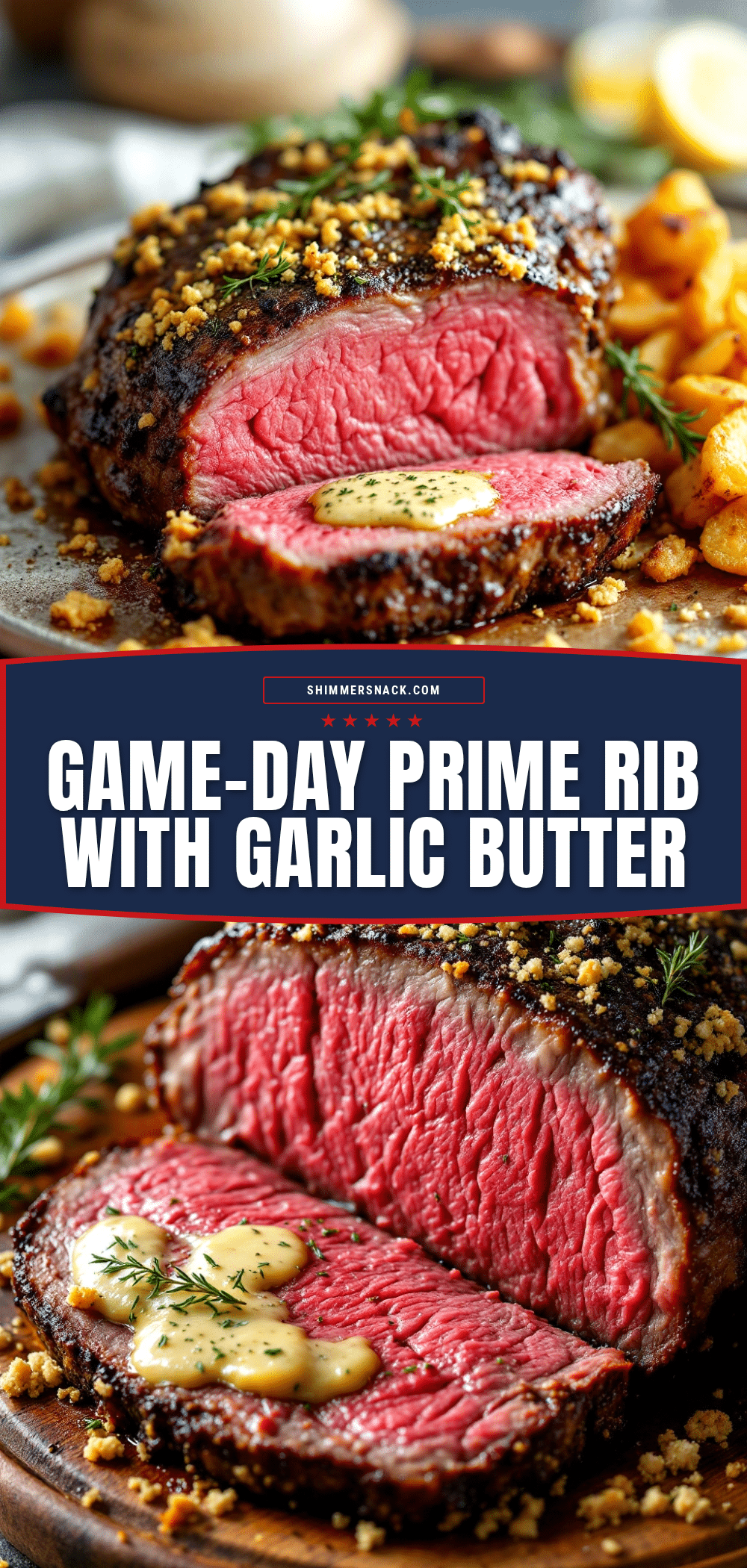
Perfect Prime Rib Roast with Garlic Herb Butter for Game Day
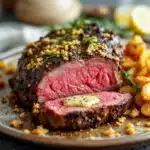
A foolproof prime rib roast recipe with garlic herb butter that creates a crispy, savory crust and perfectly tender interior. Ideal for game day or any special occasion, this low-and-slow method with a final high-heat sear ensures impressive results every time.
- Prep Time: 1 hour 20 minutes
- Cook Time: 2 hours 15 minutes
- Total Time: 3 hours 35 minutes
- Yield: 8 servings 1x
- Category: Main Course
- Cuisine: American
Ingredients
- 1 (6-8 pound) bone-in prime rib roast
- 1 tablespoon kosher salt
- 1 teaspoon freshly ground black pepper
- 1/2 cup unsalted butter, softened
- 6 cloves garlic, minced
- 2 tablespoons fresh rosemary, finely chopped
- 2 tablespoons fresh thyme leaves
- 1 tablespoon fresh parsley, chopped
- 1 teaspoon flaky sea salt
- 1/2 teaspoon red pepper flakes (optional)
- 1 cup beef broth
- 1/4 cup dry red wine
- 1 tablespoon all-purpose flour
- Pan drippings from the roast
Instructions
- Take the chill off the roast (1 hour before cooking): Remove the prime rib from the refrigerator and let it sit at room temperature for about 1 hour. Pat the roast dry with paper towels.
- Make the garlic herb butter (15 minutes): In a small bowl, combine the softened butter, minced garlic, chopped rosemary, thyme, parsley, flaky sea salt, and red pepper flakes (if using). Mash together with a fork until well combined. Set aside at room temperature.
- Season the roast (5 minutes): Rub the entire surface of the roast with the kosher salt and black pepper. Then, using your hands, generously spread the garlic herb butter all over the roast, covering every inch. If time allows, wrap in plastic wrap and refrigerate overnight.
- Preheat the oven (20 minutes): Position a rack in the lower third of your oven and preheat to 450°F (232°C).
- Roast at high heat (15 minutes): Place the roast bone-side down on the rack in your roasting pan. Roast at 450°F for 15 minutes. Do not open the oven door.
- Lower the heat and continue roasting (2-2.5 hours): Reduce the oven temperature to 325°F (163°C). Continue roasting until the internal temperature reaches 120°F (49°C) for rare, 125°F (52°C) for medium-rare, or 130°F (54°C) for medium. Insert thermometer into the thickest part of the meat, avoiding the bone.
- Rest the roast (20-30 minutes): Remove the roast from the oven and transfer to a cutting board. Tent loosely with aluminum foil and let rest for at least 20 minutes.
- Make the au jus (10 minutes, while the roast rests): Place the roasting pan on the stovetop over medium heat. Add the beef broth and red wine, scraping up any browned bits. Whisk in the flour and let simmer for 3-4 minutes until thickened. Strain if desired. Season with salt and pepper.
- Slice and serve (5 minutes): Remove kitchen twine. Slice between the bones to separate them from the roast. Slice the meat against the grain into 1/2-inch thick slices. Arrange on a platter, spoon some au jus over the top, and serve immediately.
Notes
For best results, dry brine the roast overnight with the garlic herb butter. Use a meat thermometer for accurate doneness. Let the roast rest for at least 20 minutes before slicing to retain juices. If making au jus gluten-free, omit the flour or use a gluten-free alternative.
Nutrition
- Serving Size: 6 oz serving (withou
- Calories: 450
- Sodium: 600
- Fat: 30
- Saturated Fat: 12
- Carbohydrates: 1
- Protein: 45
Keywords: prime rib, garlic herb butter, game day, roast beef, holiday, special occasion, beef roast